Fluid Art Pouring Order of Colors to Avoid Muddyness

While the practice of pouring artist paints is certainly not a new way to apply paint, achieving consistent results tin be frustrating and plush. However, it is vital to the procedure to conduct experiments to proceeds the knowledge of what are the almost critical controlling factors which preside over paint pours.
Studio Preparation
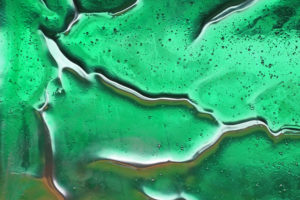
I certain way to meliorate the odds for successful pouring is to offset with a make clean studio. Acrylic pours are relatively wearisome drying paint layers and dust can hands go imbedded into the picture. Take some time to gratuitous the immediate workspace, sweeping the flooring and wiping downwardly surfaces around the studio. Adjacent, exist sure the tabular array acme or floor you are working on is also clean and level. Even slight angles can cause issues withpours. Put down fresh poly plastic sheeting on the surface which will protect the surface andassistance later on by preventing your artwork from condign glued to the work surface, as pouring products creates puddles and drips that can travel off of the canvas or console. Finally, control the temperature and humidity level in the studio as much as possible. Dry climates increment the chance of crazes developing – fissures resulting from liquid acrylic products skinning over during initial drying while the underlying liquid pigment is however very fresh. The skin shrinks and tears apart resulting in unwanted physical textures known as a "craze" (meet Prototype 1).
Painting Substrates
The nearly predictable painting surface for pours is a sealed panel. This surface is less afflicted by the weight of the wet product compared to stretched canvas. Of course, the console needs to be resistant to warping from water, thus sealing the surface with i or more than coats of acrylic medium (or paint) is helpful. Conversely, this advice may be counter-productive if your technique relies upon the surface absorbency and/or the power to curve the substrate in gild to control the paint movement. This is why testing is such a critical factor even when using products that other artists find successful. If working on stretched canvas is vital to your process, you may be able to eliminate the sagging by stretching over a wooden panel or using a cardboard block between the stretcher bars.
Paints and Mediums used for Pouring Applications
Free-flowing liquid paints and mediums are at the middle of the pouring process. Adjusting the viscosity and flow charge per unit to work in tandem with how you want the paints to collaborate with each other is key. Obviously, products like GOLDEN Fluid Acrylics and Loftier Flow Acrylics are more applied when doing pours than thicker Heavy Body Acrylics. This is not to say you cannot utilise Heavy Body paints, just they will first crave thinning with water, acrylic medium, or both. A cracking arroyo for thinning Heavy Body paints without a loss of film forcefulness is to beginning mix a sparse acrylic medium such every bit GAC 100 with water (1 role medium to 1.5 parts water, and and so use this mixture to sparse the paints as much as desired). This mixture assures quick thinning but contains enough acrylic binder then that you still finish up with a pourable pigment instead of a color stain mixture. Since Fluids and High Menstruation Acrylics are already pourable, this footstep isn't required to piece of work with them, but sometimes information technology is necessary to accommodate these paints as well. GOLDEN Airbrush Transparent Extender is also a valuable medium for adjusting paints. This product is a similar consistency to High Menstruum Acrylics, containing flow improvers and leveling additives.
Although most acrylic mediums are inherently pourable, some are better suited for pouring than others. GAC 800 is a medium specifically produced to alter paints for pouring, such as when pouring a puddle onto a paint surface. The GAC 800 mixes readily with the Fluid Acrylics and this combination is the to the lowest degree likely to craze during drying. It'due south still possible GAC 800 may craze, but this is usually the event of too much paint beingness added and in turn, countering the acrylic solids level or the pour has been applied in likewise thick of a layer. A great starting point is to mix i office paint into ten parts GAC 800 and limit the thickness to how far the product will spread. In other words, cascade the product into a pancake puddle, and let it seek its own thickness without impeding its menstruum by use of a taped off or dammed edge. Once these tests are washed you may want to attempt other paint amounts and utilize edges to control the menses, only exist wary of too thick of a pour to outset. The biggest negative aspect of GAC 800 is "dry country clarity". This medium retains a slight cloudy quality making it a poor choice as a clear topcoat or fifty-fifty transparent colour layer.
Other mediums to experiment with include GAC 500, Polymer Medium (Gloss), Fluid Matte Medium, Self-Leveling Clear Gel and Articulate Tar Gel. One important annotation worth mentioning is that these products were non adult with defect-free pouring in listen, and although smooth sparse layers are possible when using them, they are not gratis of problems and limitations. For example, a common misconception is that Cocky-Leveling Clear Gel can be poured liberally and spread around with palette knives, trowels and squeegees and level perfectly upon drying. This is not the case, and some tool marks, nevertheless slight, will likely remain in the dried layer. Tool shape and application technique are critical to their success, and artists who have mastered their use have spent many frustrating nights in their studio figuring out the best application method that provides the desired results. Equally a identify to showtime, employ clean, large tools with smooth edges and carefully spread the production in multiple thin coats until the desired effect is attained. Allow ane to 3 days drying between coats to reduce the take a chance of crazing and don't exist put off if every layer isn't a perfect epoxy like surface, as perfection is nearly impossible to reach in layers of air drying products.
Pouring Application Techniques
There are as many methods as there are product combinations to attempt. Outset, appreciate each paint color equally its ain unique formula and pigments vary in their density and power to move and spread. The same is true for the many acrylic mediums produced. Now factor in the improver of water, Retarder, or diluted Acrylic Period Release. Toss in the impact of the painting substrate and studio surround and suddenly, anticipated pouring seems unattainable. The way to best describe the approach to pouring applications is the concept of setting the phase to allow the products to practise what they want to do; in other words, controlled chaos. And if yous don't accept expert studio notes to identify how each painting is created and so you'll never exist able to reproduce a great upshot when they happen. That said, here are some common methods and beginning mixtures to try out:
- Thinned Color Washes – High Flow Acrylics are set up to use for this application. The colors will readily motion and interact. Try them groovy, mixed with mediums like Airbrush Transparent Extender or GAC 500 and permit gravity move them around. Fluid Acrylics will require at least 10% additions with h2o to allow them to freely move about. Note: high additions of h2o increment surface tension, which can be countered by adding in 2 or 3% Acrylic Flow Release into the water prior to using it to thin paints. Practice not over-add Acrylic Menses Release as information technology does not assistance amend flow, information technology's intended to reduce surface tension which happens rapidly.
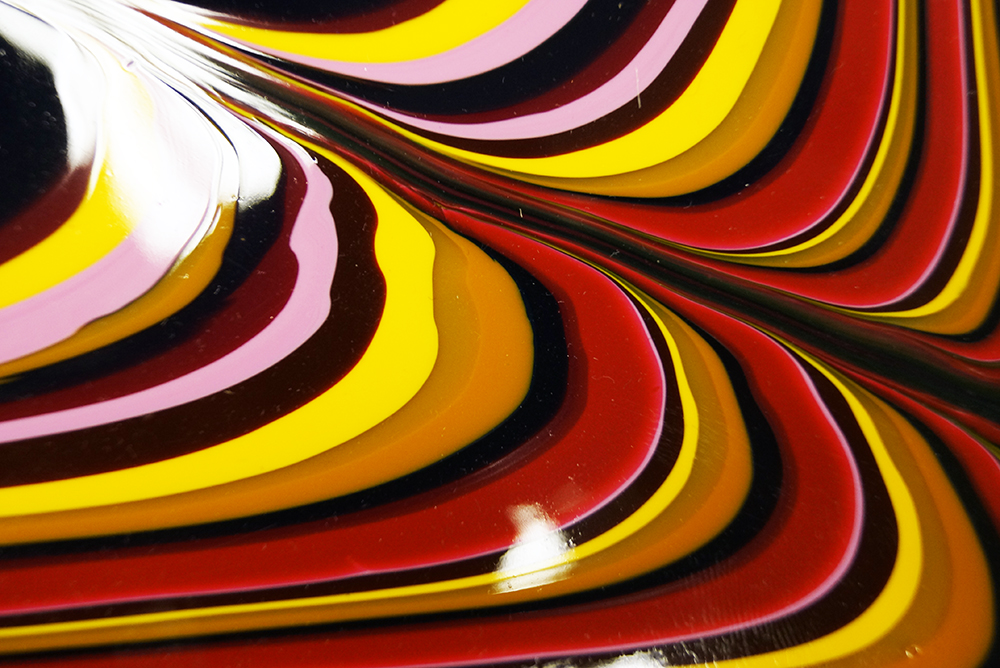
- Solid Color Pours – As mentioned previously, GAC 800 is a great medium to apply with Fluid Acrylics for making colored pours (see Image 2). Ideally start around x parts GAC 800 to 1 role Fluid Acrylic, mix and store the paint overnight in a sealed container. This allows the bubbling incurred during mixing to rise and popular, resulting in make clean pours with sharp edges. These mixtures produce clear color edges. Solid color pours can be used over an entire canvas, but avert damming up the edges during drying.
- Calculation Isopropyl Alcohol into Acrylic Paint – Alcohol is less dense than h2o, and evaporates rapidly once it hits the surface of a pour. Unlike other applications, the alcohol corporeality for this technique is relatively low because once the effect happens and it escapes the fresh cascade, there needs to be sufficient time for the normal acrylic paint curing process to
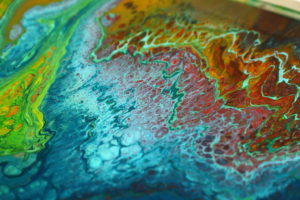
Image 3: Pours of GAC 800, GOLDEN High Flow Acrylic & Isopropyl Booze create cellular patterns as the booze tries to escape the paint during drying. occur to avert film formation bug. An effective starting recipe is two parts GAC 800, 1 part Loftier Flow Acrylic, and 1 office 70% isopropyl booze. Create 3 or more pigment mixtures in containers which can be shaken without spilling and carefully pour one color on tiptop of another. Dumbo pigments like Titanium White should be used as the final layers so that the more aggressive colors below volition push up through and create the cellular effects (see Image 3).
Conclusion
Every bit with whatever new painting technique, do not be discouraged if the desired results don't happen immediately. Good note taking is critical for successful pours of acrylic paints and mediums. If you lot detect yourself at the crossroads and need additional guidance, delight contact the Materials Specialists with your questions!
Source: https://justpaint.org/understanding-the-techniques-of-pouring-acrylics/

Post a Comment for "Fluid Art Pouring Order of Colors to Avoid Muddyness"